27Gr95Qe B First Look: Unboxing and Impressions
The landscape of enthusiast-grade monitors has undergone a seismic shift over the last year, moving away from the traditional dominance of IPS and VA panels toward the high-contrast, high-speed world of organic light-emitting diodes. At the center of this revolution is the 27Gr95Qe B, a display that represents a specific milestone for professional gamers and display purists alike. While the market has been flooded with ultra-wide screens and massive 42-inch desktop companions, the 27Gr95Qe B occupies the "Golden Ratio" of desktop gaming: a 27-inch footprint combined with a 2560 x 1440 resolution. This article provides a comprehensive editorial analysis of the hardware, the initial experience of integrating it into a workstation, and how it measures up against the rigorous demands of modern digital environments.
Integration and Initial Presentation
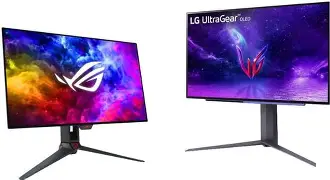
Upon unboxing the 27Gr95Qe B, the first detail that strikes the observer is the physical profile of the panel itself. Because OLED technology does not require a traditional backlight assembly, the edges of the display are remarkably thin, measuring only a few millimeters. This creates a striking aesthetic on the desk, though it requires careful handling during the assembly process to avoid putting undue pressure on the glass. The stand assembly follows a modular design, clicking into the back of the monitor with a standard VESA-compatible tension system. The base is relatively compact compared to older "gamer-centric" displays, opting for a flattened V-shape that allows for more keyboard and mousepad clearance—a critical consideration for low-sensitivity competitive gamers who require wide, sweeping arm movements during play.
The connectivity suite located at the rear of the device is positioned for easy access, featuring a mix of HDMI 2.1 and DisplayPort 1.4 ports. The inclusion of HDMI 2.1 is particularly noteworthy for users who juggle a PC and high-end gaming consoles, as it allows for full bandwidth 4K downsampling or 1440p high-refresh-rate output with Variable Refresh Rate (VRR). Additionally, the monitor includes a dedicated optical audio output and a high-quality headphone jack with DTS Headphone:X support, emphasizing that this unit is intended to be a central hub for a complete multimedia experience.
Performance Analysis: The OLED Advantage
The primary draw of the 27Gr95Qe B is its self-emissive pixel structure. Unlike traditional LCDs that rely on a backlight that must remain partially "on" even during dark scenes, every pixel on this panel can turn off completely. This results in an infinite contrast ratio and "true blacks" that are physically impossible to achieve on an IPS panel, even those with expensive mini-LED local dimming zones. In practical use, this means that in high-contrast scenarios—think of a space-based game where a bright white ship sits against the void of space—there is zero "blooming" or haloing. The darkness is absolute, which provides an incredible sense of depth and three-dimensionality to the image.
Color reproduction on the 27Gr95Qe B is equally impressive. The panel covers a vast majority of the DCI-P3 color gamut, making it more than capable for light creative work in addition to entertainment. Out of the box, the colors are vibrant without appearing overly saturated, though the "Gamer" modes often push the blues and greens slightly higher to create a sense of "pop." For those concerned with accuracy, the hardware supports hardware calibration through dedicated sensors, allowing professional users to maintain a consistent color profile over time—a feature rarely seen in models marketed primarily toward the gaming community.
The Speed Paradigm: 240Hz and Instant Response
While the visual quality is substantial, the 27Gr95Qe B is built for speed. With a 240Hz refresh rate, the monitor updates the image every 4.1 milliseconds. However, the refresh rate tells only half the story. The pixel response time—the speed at which a pixel can change from one color to another—is rated at 0.03ms (GtG). This is several orders of magnitude faster than the best "Fast IPS" panels, which typically hover around 1.0ms or 0.5ms. In fast-motion scenarios, such as tracking a target in a first-person shooter or scrolling through a dense spreadsheet, there is virtually zero motion blur. The image remains as clear during movement as it does when static, which significantly reduces eye strain and improves mechanical performance in competitive environments.
Real-World Use Cases
To understand the value proposition of the 27Gr95Qe B, one must look at how it handles diverse workloads. While it is marketed as a gaming monitor, the editorial perspective must consider its utility in a modern "hybrid" lifestyle where the same desk is used for productivity and leisure.
Competitive Gaming
In the realm of esports, the 27Gr95Qe B is a transformative tool. The combination of 240Hz and OLED response times means that technical limitations of the display no longer bottleneck the player. Specifically, the clarity provided in dark corners of a map allows for better target acquisition. Players who move from a 144s IPS panel to this 240Hz OLED often report a "smoothness" that feels almost like looking through a window rather than a screen. The 27-inch size also fits perfectly within the human field of view without requiring significant head movement, which is why it remains the industry standard for competitive play.
Productivity and Text Clarity
For office work, the 27Gr95Qe B faces a unique challenge common to all OLEDs: the subpixel layout. Traditional monitors use an RGB subpixel arrangement that Windows and macOS are optimized to render. This OLED utilizes a RWGB layout, which can occasionally lead to slight fringing around high-contrast text. While most users will not notice this during casual browsing, those spent eight hours a day editing text or writing code may find it less "crisp" than a 4K IPS panel of the same size. However, the benefit of the matte coating on this model is that it significantly cuts down on reflections from office windows or overhead lights, making it a viable option for bright rooms.
Shop the latest Electronics picks on Amazon.
See Deals →Cinematic Media Consumption
Watching 4K HDR content on the 27Gr95Qe B is where the display truly shines. Because it supports HDR10 and has the infinite contrast of OLED, the dynamic range is staggering. Fire, explosions, and sunlight look intensely bright against dark backgrounds. It provides a theater-like experience that portable laptops or standard desktop monitors cannot replicate. For users who watch movies or high-end television series at their desk, this display likely offers the best visual fidelity available in the 27-inch market.
Comparative Analysis
When selecting a high-end display, buyers often weigh the 27Gr95Qe B against older IPS technology or larger OLED televisions used as monitors. The following table highlights the technical differences that cater to various buyer preferences.
| Feature | 27Gr95Qe B (OLED) | Premium Fast IPS | 42-inch OLED TV |
|---|---|---|---|
| Contrast Ratio | Infinite:1 | 1,000:1 to 1,200:1 | Infinite:1 |
| Pixel Response Time | 0.03ms | 0.5ms - 1.0ms | 0.1ms |
| Desktop Ergonomics | Excellent (27") | Excellent (27") | Poor (Requires deep desk) |
| Text Clarity | Good (RWGB) | Excellent (Standard RGB) | Fair (Due to size/PPI) |
| Burn-in Risk | Present (Mitigated by software) | None | Present |
Pros and Cons
Every piece of technology involves trade-offs. The 27Gr95Qe B is a specialist tool designed for high-end enthusiasts, and its list of advantages and disadvantages reflects that focus.
- Unmatched Contrast: The ability to render perfect blacks changes the way dark media and games look, providing a level of immersion that LCD technology cannot match.
- Elite Motion Clarity: The combination of 240Hz and near-instant response times makes this one of the fastest displays on the market, ideal for competitive gaming.
- HDR Performance: While not as bright as some flagship TVs, the per-pixel dimming allows for a highly impactful HDR experience without any "blooming" artifacts.
- Physical Design: The ultra-thin panel and functional stand mean it looks great on a desk and doesn't take up excessive space.
- Connectivity: HDMI 2.1 support ensures that the monitor is future-proof for the current generation of consoles and high-end GPUs.
- Maximum Peak Brightness: Since OLED is an organic technology, it cannot reach the searing brightness levels of some Mini-LED displays. It is best used in a light-controlled room.
- Subpixel Fringing: Careful users may notice slight softness in text rendering due to the RWGB subpixel structure, though this is largely dependent on individual sensitivity.
- OLED Care Requirements: This monitor requires occasional "Pixel Cleaning" cycles and a bit more mindfulness regarding static UI elements to avoid image retention over several years.
- External Power Brick: To keep the panel slim, the power supply is moved to an external brick, which requires a bit more cable management under the desk.
Comprehensive Buying Guide
Buying a monitor in this price bracket requires an understanding of your specific needs. The 27Gr95Qe B is not a "one size fits all" display; it is a precision instrument for a specific type of user. To determine if this display is the right investment, consider the following environmental and usage factors.
Environmental Considerations
OLED technology is inherently prone to reflections because the pixels are closer to the glass surface. The 27Gr95Qe B utilizes a specialized matte anti-glare coating that is quite effective. However, if your desk is directly in front of a south-facing window with direct sunlight, the "inky blacks" can lose their impact. This monitor performs best in "dim" to "moderately lit" environments. If you work in a very bright office with harsh overhead fluorescent lighting and no way to control it, a high-brightness IPS or Mini-LED panel might be a safer choice for visibility.
Usage Habits and Longevity
A common concern with OLED is "burn-in"—the permanent retention of an image after displaying static elements for too long. For gamers who play a variety of titles and watch full-screen media, this is largely a non-issue. Modern OLED monitors like the 27Gr95Qe B include sophisticated mitigation features, such as "Screen Move" (which shifts the image by a few pixels periodically) and "Screen Saver" modes. However, if you are a professional who leaves a static Excel spreadsheet or a fixed DAW interface open for 10 hours a day, every day, your risk profile is higher. In such cases, using a secondary cheaper monitor for static tools is a recommended strategy to preserve the health of the OLED panel.
Hardware Requirements
To truly take advantage of a 1440p 240Hz OLED, you need the computer hardware to back it up. While 1440p is much easier to drive than 4K, hitting a consistent 240 frames per second in modern titles requires a powerful Graphics Processing Unit (GPU) and a modern Processor (CPU). If your current system struggles to maintain 100 FPS, you will still benefit from the OLED's contrast and response times, but you won't be seeing the full potential of the 240Hz refresh rate. It is often better to ensure your PC is capable of driving the resolution before investing in a high-refresh-rate display.
The Comparison with 4K
At 27 inches, 1440p provides a pixel density of approximately 108 pixels per inch (PPI). This is considered the "sweet spot" by many because it provides a sharp image without requiring excessive scaling in Windows. However, if you are coming from a 4K monitor (which offers 163 PPI at 27 inches), you may notice a slight decrease in the "tightness" of the image. For most gamers, the trade-off—gaining 240Hz and OLED contrast in exchange for a little pixel density—is worth it, as 1440p allows for much higher frame rates in games than 4K.
Looking for the best Electronics deals on Amazon?
Shop Amazon →Advanced Features and Calibration
Beyond the primary panel specs, the 27Gr95Qe B offers a suite of software features designed to improve the user experience. The on-screen display (OSD) is controlled via a small joystick or an included remote control, allowing for quick adjustments to brightness, input, and game-specific settings like a black stabilizer (which lifts shadows to help see enemies) or an on-screen crosshair.
One of the most impressive technical aspects is the support for hardware calibration. While most monitors rely on software-side color profiles (ICC profiles) which can be inconsistent, this monitor allows you to save calibration data directly into the monitor's internal hardware. Using compatible calibration software, a user can ensure that the "Red" the computer asks for is exactly the "Red" the monitor displays. This bridges the gap between a pure gaming display and a display that can be used for semi-professional photo and video editing.
Furthermore, the 27Gr95Qe B is equipped with G-Sync Compatible and FreeSync Premium Pro certifications. This ensures that the monitor's refresh rate synchronizes perfectly with the GPU's frame output, eliminating screen tearing and stuttering. In an OLED, this synchronization is even more critical because the instant response times can make "micro-stutters" feel more apparent than they would on a slower LCD panel. Having robust VRR (Variable Refresh Rate) support is a non-negotiable feature for a display of this caliber.
The Impact of the Matte Finish
A significant point of discussion in the community regarding the 27Gr95Qe B is its matte finish. Historically, many OLED TVs have used glossy finishes to maximize perceived contrast. The 27Gr95Qe B opts for a matte coating, which has been designed to be as "unobtrusive" as possible. This was a deliberate choice by the engineers to cater to the desktop environment, where light sources are harder to control than in a living room. The coating does an admirable job of diffusing reflections without the "grainy" or "oily" look that older matte monitors sometimes suffered from. It maintains the deep blacks while allowing the monitor to be used comfortably during the day. For an editorial perspective, this makes the 27Gr95Qe B a much more versatile tool for a variety of room types, even if it loses a tiny fraction of that "glossy pop" that some enthusiasts crave.
Weight and Mounting
Stability is often overlooked in monitor reviews, but the 27Gr95Qe B handles it well. Despite the panel being thin, the housing is sturdy. The stand provides tilt, height, and pivot adjustments, allowing the monitor to be turned 90 degrees into a vertical orientation. For those who prefer a clean desk look, the monitor's light weight makes it an ideal candidate for aftermarket monitor arms. Standard gas-spring arms will have no trouble supporting the panel, and the slim profile ensures it won't protrude too far forward, leaving more room for your peripherals.
Conclusion
The 27Gr95Qe B is a landmark product in the evolution of the desktop display. It takes the most sought-after features of television technology—the infinite contrast and incredible speed of OLED—and successfully shrinks them into a form factor that is practical for the average desk and optimized for the high-speed requirements of modern gaming. While it asks users to be mindful of its organic nature and specific brightness limitations, the rewards it offers are substantial. For those who spend their time in visually rich game worlds or competitive arenas, the visual clarity and responsiveness provided here are difficult to go back from once experienced. It is a specialized, high-performance display that sets a new standard for what we should expect from a 27-inch monitor in the current era. It represents not just a minor upgrade over the previous generation of IPS displays, but a fundamental change in the visual quality of the desktop experience.